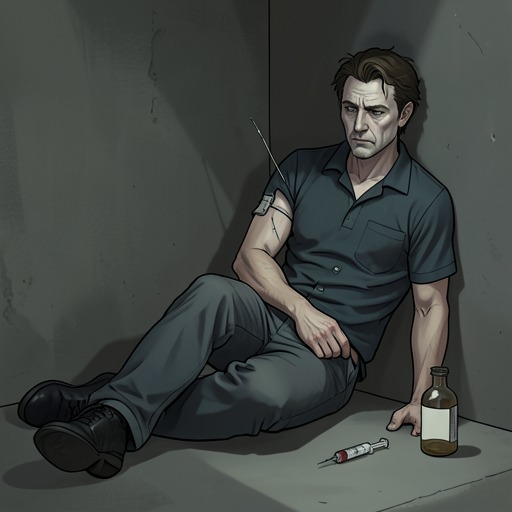
Heroin addiction
Hide and SeekHeroin addiction is the condition shaping Ronnie McGrath’s life and the circumstances of his death. It began while he was still at school, strained his ties with his family, and left him vulnerable to a lethal supply. His brother Neil’s account shows how care and admiration could coexist with helplessness; the investigation into Ronnie’s death, meanwhile, places his dependence within a city where intravenous drug use was widespread and dangerous drugs could circulate with little scrutiny.
Identity and Development
Neil says Ronnie began taking drugs while they were at school. Ronnie was caught and came close to expulsion, but the school let him return after three months so he could sit his exams; he passed them all. That episode establishes the addiction as an early part of Ronnie’s life, before his disappearance from home and the later events surrounding his death.
After the exams, Ronnie ran away. His parents went nearly frantic while he was missing, then shut him out, and Neil was not supposed to mention his brother in the family home. The separation was not evidence that Ronnie had recovered: Neil later encountered him in such a state that he helped him home. When Neil returned the following day, Ronnie was surprised to see him and did not remember that Neil had helped him the night before. The episode gives a concrete measure of the impairment Neil witnessed, without turning that one encounter into a complete account of Ronnie’s life.
Neil initially tried to get Ronnie off drugs. He also acknowledges that Ronnie seemed to be in control, even after Neil had found him in a severely compromised condition. Ronnie insisted that taking drugs was his choice. Neil’s recollection preserves the tension between that claim of agency and the circumstances he describes: Ronnie’s condition alarmed him, yet his brother’s own account of his choices made intervention difficult. Neil’s admiration for Ronnie also clouded his judgment; Rebus recognizes that admiration could lead Neil to turn a blind eye.
Family, Care, and Distance
Neil believed he knew his older brother well, even saying he understood how Ronnie’s mind worked. His account complicates that confidence. He admits that he may not have understood Ronnie as well as he thought, and that the brothers’ contact began again after he helped Ronnie home. They remained close enough for Neil to visit, but the family’s silence and Ronnie’s separation from home had already made the relationship difficult to sustain openly.
Ronnie thought it funny that Neil was in the police force. Neil did not visit in uniform, a small practical choice that also marks the boundary between his work and his relationship with his brother. His efforts to help were personal rather than official, and the narrative does not present them as a successful route out of addiction. Neil’s care is real, but it cannot undo the estrangement or give him control over Ronnie’s decisions.
Dependence and the Fatal Supply
The account of Ronnie’s final drug use links dependence to scarcity and a newly available dose. Charlie reasons that Ronnie had gone without drugs for a long time and had just obtained some. In an empty house, Ronnie injected it; Charlie’s explanation is presented as a reconstruction, and Rebus accepts its plausibility while acknowledging Charlie’s skepticism about Tracy’s account of finding Ronnie. The scene therefore gives a likely sequence, not an independent, complete witness account of every moment.
The substance was not merely weak or uncertain: the doctor says it was about ninety-five percent impure and potentially diluted with substances ranging from ground-up aspirin to rat poison. The doctor describes it as lethal and warns that there may be more of it in circulation. When Rebus explains that Ronnie overdosed and that the drugs were lethal, Charlie recognizes the seriousness of the danger. Ronnie’s dependence thus meets an exceptionally hazardous supply, turning the act of taking the drug into a fatal risk.
Rebus’s written reconstruction makes the uncertainty around the death explicit. Ronnie had been deprived of his supply despite the city’s broader availability of drugs, and someone had moved his body. A packet of good heroin had been left behind, perhaps in the hope that it would be tested, found clean, and lead to the death being recorded as a simple overdose. But the rat poison had been found. Rebus initially struggles to establish a crime from these facts, since there is no sign that Ronnie did not inject himself; he then questions how the pieces fit together. The account distinguishes Ronnie’s addiction and fatal injection from the separate possibility that someone manipulated the circumstances of his death.
Social Setting and Significance
Ronnie’s dependence unfolds against the visible neglect of the Pilmuir Estate. Its long grass and weeds, damaged playgrounds, boarded windows, broken fences, and failing drainpipes make the surrounding deprivation concrete. Nearby, a developer advertises luxury apartments as Muir Village, but Rebus sees the estate as Pilmuir, a place being left behind. The contrast situates Ronnie’s vulnerability amid stark inequality without establishing that poverty alone caused his addiction.
The novel also presents drug use as a public-health crisis rather than an isolated personal failing. A doctor rebukes Rebus for assuming that most users now chase the dragon rather than inject, pointing him toward the Royal Infirmary and estimating that intravenous users in Edinburgh number in the hundreds. The doctor connects the scale of injection to the city’s AIDS burden. Elsewhere, a participant in a drug-related financial arrangement admits that nobody wants to know where the money comes from, because knowing could make them an accessory. Together with the lethal adulteration of the heroin, that admission suggests a supply system sustained by deliberate ignorance as well as demand.
The evidence does not reduce Ronnie to his addiction: it records his school achievement, Neil’s loyalty, and the family rupture alongside his dependence and death. Nor does it treat the overdose as proof that no one else was involved. Instead, addiction is both an intimate history, carried in the brothers’ memories and failed attempts at help, and part of a wider setting of hazardous supply, public-health risk, and neglect. The gap between Ronnie’s asserted choice and his fatal vulnerability is central to that account.